App marketing channels, ranked for a new app with no budget
A tier list of the ways to get your first app users for free: when each channel is worth your weeks, when it isn't, and how to start. Plus what to add once you have money.

·21 min read
On this page
If you're marketing an app with no budget, you won't run out of money. You'll run out of weeks. Pick the wrong channel and a month goes by with nothing to show for it.
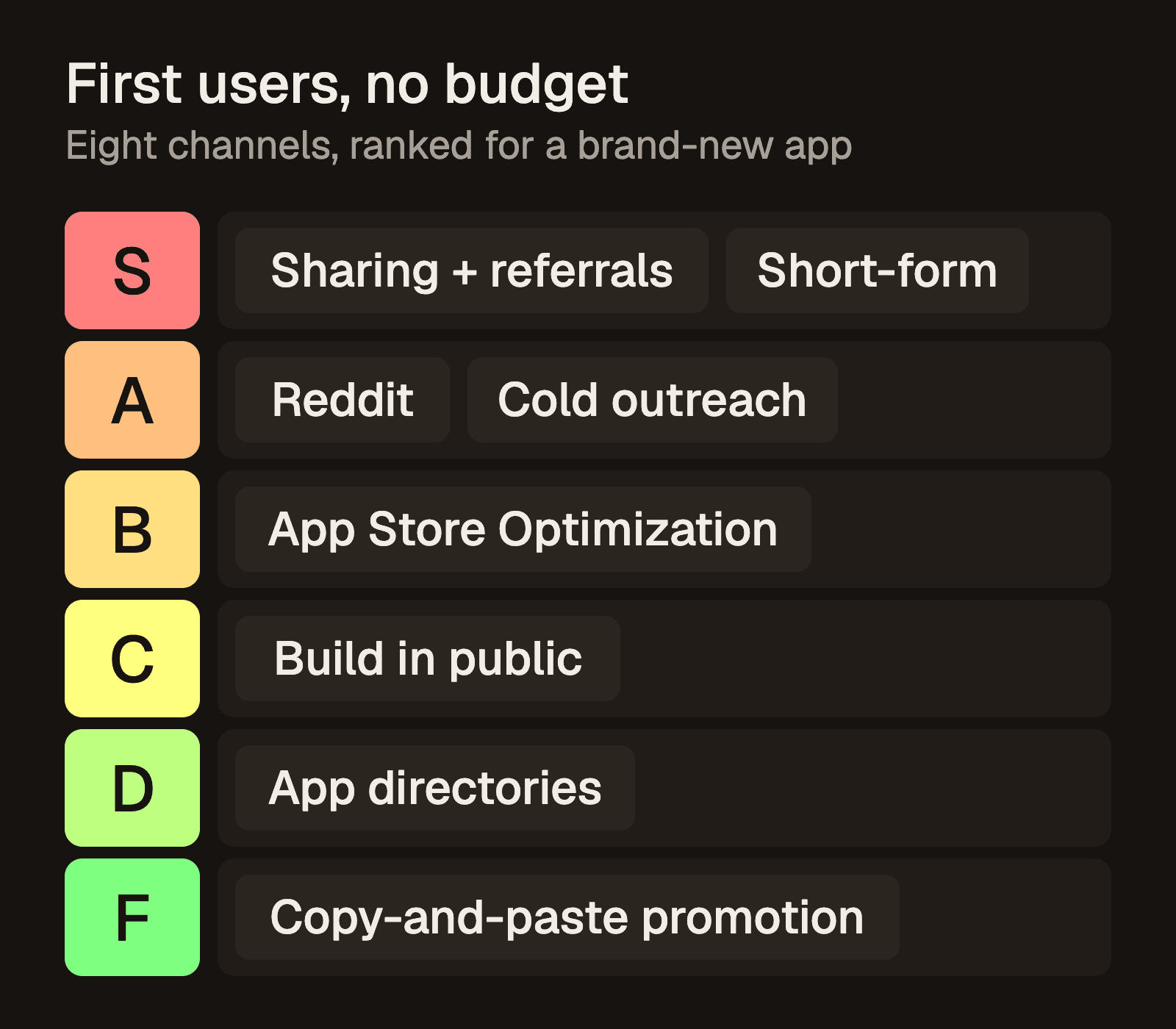
This is the long version of my tier list: the seven ways to get your first users from the video, plus one I added, ranked. For each one you get when it's worth your time, when it isn't, and how to start.
After that come the channels I left off, like paid ads, creators and SEO, and what has to be true before they earn a spot.
The short version
S tier: sharing and referrals, short-form content. A tier: Reddit, targeted cold outreach. B tier: App Store Optimization. C tier: building in public. D tier: app directories. F tier: copy-and-paste promotion.
Three questions decide the rank. Does it put your app in front of the person who has the problem? Does it give them a reason to care? And how many weeks do you lose if it doesn't work?
This ranking is for a brand-new app and no money. Channels move up and down as your app grows.
How I ranked them
1. Does it reach the person who has the problem? A thousand views from other app builders are worth less than ten from people who need what you built.
2. Does it give them a reason to care? A link isn't a reason. Neither is "check out my app."
3. What does it cost if it fails? With no budget, you pay in time. A channel you can test in an afternoon beats one that takes three months to tell you no.
Sharing and referrals: S tier
Your users bring in your next users. It's at the top because it makes every other channel on this list worth more.
Say a video gets you 100 users, and every two of them bring in one friend. Those 100 bring in 50. The 50 bring in 25, then about 12, and so on. If that rate holds, your 100 users turn into about 200. Same video, twice the result.
Use it when people already use your app and get something out of it they'd want another person to see.
Skip it when you have no users yet, or the ones you have don't come back. Sharing spreads whatever is already there. If people don't like the app, it spreads that faster.
How to start
- Find the moment your app gives someone the most value. That's where the ask goes. Not the settings screen.
- Make the result the thing they share. Wordle's share button posts a grid of colored squares: how you did, with no spoilers. It went from 90 players on November 1, 2021 to more than 300,000 two months later, according to the New York Times.
- Give the friend a reason to say yes. Dropbox gives extra storage to both people. Today that's 500 MB each on a free account.
- Track it with a code. The App Store doesn't tell you who invited whom. A short code the new person types in at sign-up works on both stores and can ship this week.
What people miss: an "Invite your friends" button isn't a reason to share. Nobody opens an app hoping to do its marketing. Give them something they'd send to a friend anyway.
I wrote a full guide on picking the reward: Pick the referral program that fits your app.
Short-form content: S tier
One video can put your app in front of more strangers than a month of everything else on this list, and posting is free.
The format is simple. Show the problem, then show your app solving it. You don't need to be on camera. A screen recording works.
Locket is the cleanest example. Matt Moss built it alone and launched on January 1, 2022. He posted TikToks of the app in use. Eleven days later it was the No. 1 app on the US App Store with over 2 million sign-ups, and he told TechCrunch there were no paid ads and no paid influencers.
A new account isn't locked out, either. Instagram's head, Adam Mosseri, said in January 2025 that the three signals that matter most are watch time, likes and sends, and that sends count a little more for reaching people who don't follow you. TikTok says follower count isn't a direct factor in what it recommends.
Use it when someone can see what your app does in a few seconds of screen.
Skip it when the payoff only shows up after weeks of use and there's nothing to show. Also skip it if you know you'll post three times and stop.
How to start
- Open on the problem. Instagram's own advice is to pull people in within the first 3 seconds.
- Record your screen fixing it. Vertical, full screen, no watermark, under 3 minutes. Instagram says it won't recommend reels that are watermarked or longer than that.
- Post it as a carousel too. Photos with text over them count as short-form. Mosseri has said carousels with music are eligible for the Reels tab.
- Test hooks on strangers. Instagram's trial reels only go to people who don't follow you. You need a public account, and 200 followers if it's a professional account (1,000 if it's personal).
- On TikTok, turn on the disclosure setting. TikTok requires it when you promote your own app, not just someone else's. The post gets a "Promotional content" label, and TikTok says it doesn't affect reach.
- Watch sends and watch time. Make more of whatever people send to each other.
What people miss: one viral video is all it takes, but you don't get to pick which one. In data from viral.app, a company that sells creator posting (so read it as a vendor's numbers), app accounts that posted 20 to 39 TikToks in a month had a 100,000-view video in 28% of those months. Accounts that posted 1 to 4 times had one in 7%. Volume is how you get your one.
And a spike isn't a business. Poparazzi hyped itself to No. 1 on the App Store on TikTok in 2021 and shut down two years later. Make sure people come back before you chase the spike: growth isn't marketing.
Reddit: A tier
People on Reddit are literally posting about problems they need help with, in their own words. Some of them are asking for the exact app you built.
Use it when your users gather in specific communities around the problem.
Skip it when you can't find anyone talking about the problem, or when your plan is to drop a link and leave.
Three things about how Reddit works that most advice gets wrong:
- Promotion isn't banned sitewide. Reddit tells moderators that "promotional content is not inherently considered to be spam," and in the same breath that some communities ban it completely. Each subreddit sets its own rules, usually in the sidebar.
- There's no official 10% rule. Reddit describes it as something "other communities abide by." It's a habit in some subreddits, not a law.
- Your answer keeps working after the thread goes quiet. In early 2026, about 75 million of Reddit's 127 million daily visitors were logged out. Those are mostly people who landed on a thread from a search.
How to start
- Search for the problem, not your app. Reddit search takes filters like
title:andsubreddit:, sotitle:"is there an app"inside the right subreddit finds people asking. - Read the rules before you type. Some subreddits have a flair or a day for sharing what you made. Some ban it outright.
- Answer the whole question. A stranger should get something useful without downloading anything.
- Say you built it. Reddit's rules say not to mislead people about who you are. "I made an app for this" reads better than pretending you just found it.
- Pick one community and stay. Weeks in one place beat one post in ten.
Who did it: the solo developer behind AnyTracker, a price-tracking app, posted it in r/androidapps and reached about 1,000 downloads in the first week. Then downloads dried up until a YouTuber covered it. That subreddit bans self-promotion today, which is the real lesson: check the rules now, not what worked for someone last year.
Discord's founders got 50 users in a day from one thread in a Final Fantasy subreddit, then 100 the next day. What made it stick is what they did after: they sat in the chat and talked to every person who showed up.
Who got burned: one founder made a new account and posted about his app five times in a week across four subreddits. Reddit suspended the whole account for spam, and the appeal was denied.
What people miss: the words in those posts are free copywriting. When people describe the problem themselves, they're telling you what to put in your App Store subtitle and your first screenshot.
This guide has a prompt that finds the threads for you: Find your first users with AI.
Targeted cold outreach: A tier
You message one specific person who clearly has the problem, with something only they could have received.
Paul Graham put it plainly in Do Things that Don't Scale: "The most common unscalable thing founders have to do at the start is to recruit users manually." His math is the reason it's worth it. With 100 users, you only need 10 more next week to grow 10% a week.
Pinterest started this way. Ben Silbermann emailed his friends and, in his words, "no one really got it." So he went to a conference for the design bloggers his early users read, and met them in person.
It's how my own app got going too. Prospect Ping reached its first 1,300 users without a dollar of ads. I messaged small baseball creators one at a time, and answered questions in the groups and forums where fans already talked.
Use it when you can name 50 specific people who have the problem: people who posted about it, creators in the niche, admins of the group where your users hang out.
Skip it when your list is scraped or bought, or you'd send everyone the same message. That's the F tier at the bottom of this page.
How to start
- List 50 people, not 5,000. One at a time, with a note on why each one.
- Open with their problem. Quote the post they wrote or the video they made.
- Ask a question before you ask for a download. "Did you ever find something for this?" gets replies. A link doesn't.
- Follow up once. Then leave them alone.
- Talk to everyone who says yes. That's where you learn what to fix.
Know the rules first
- Instagram: since 2023, you get one text-only message to someone who doesn't follow you until they accept the request.
- X: its rules ban "sending identical direct messages."
- Email in the US: the CAN-SPAM Act doesn't require permission first. It does require honest headers, your postal address and a working opt-out, honored within 10 business days. Penalties run up to $53,088 per email.
- Email and DMs in the UK: the regulator says you need consent to send marketing to individuals, and that this covers direct messages on social media too. Other countries have their own rules. This isn't legal advice, so check yours.
What people miss: the first hundred users you recruit by hand are also your research. Nikita Bier, who built tbh, says the hand-recruited users were how his team tested apps, not how they grew them. The point is finding out fast whether anyone wants it.
App Store Optimization: B tier
ASO is your App Store name, subtitle, keywords and screenshots. It brings in people who are already searching. It's B tier because you shouldn't rely on it to grow.
Here's what Apple says decides search results: "text relevance (matches for your app's title, subtitle, keywords, and primary category), as well as user behavior (downloads, ratings and reviews, and more)."
The first half is yours to control today. The second half is the catch: a new app has no downloads and no ratings.
Apple also says 70% of App Store visitors use search and "almost 65% of downloads happen directly after a search." Two things to know before you get excited. That stat is from 2022 and sits on Apple's ad sales page. And it includes everyone typing "Instagram" into the search bar.
Use it when people already search for what your app does, like "habit tracker" or "meal planner."
Don't lean on it when your app is a new kind of thing nobody types into a search bar yet. ASO collects demand. It can't create it.
How to start
- Use all three text fields. On the App Store, your name and subtitle get 30 characters each and the keyword field gets 100. Apple says not to repeat a word across them.
- Don't stuff the rest. Apple says promotional text doesn't affect ranking and tells you not to pack the description with keywords. Google Play has no keyword field at all: your title (30 characters), short description (80) and full description do that job.
- Go after smaller terms. Apple's own guidance is that popular terms are "highly competitive" and less common ones are easier to rank for.
- Treat your first screenshot as the ad. Your first one to three screenshots show up right in the search results.
- Ask for ratings at a good moment. Apple says ratings and reviews influence your rank. The system prompt can only appear three times a year per person, so don't spend it on day one.
- Test for free. Apple's product page optimization lets you run up to three versions of your icon and screenshots against the original.
What people miss: you'll read that Apple now reads the text inside your screenshots. Apple hasn't confirmed that. One ASO company reported it in 2025, and a test by another found 1 unexplained case in 64 phrases. Write captions for people.
If your screenshots need work, start here: Make App Store screenshots with AI, straight from the Simulator.
Building in public: C tier
You post your progress while you build: screenshots, numbers, what broke. Usually on X.
It's C tier because of who's watching. Mostly other builders. They'll cheer, and a few will try the app. But unless your app is for builders, they aren't the person with the problem.
Use it when your users are builders, like developer tools or apps for founders and creators. Or when you want feedback and a reason to keep shipping more than you want downloads.
Skip it when you're counting on it for the first users of a consumer app.
How to start
- Post the thing, not a paragraph about it. A screenshot of the main screen is what took off for the app below.
- Ask one specific question per post. "Which of these two onboarding screens is clearer?" gets answers. "Thoughts?" doesn't.
- Talk to everyone who tries it. Ask what they expected the app to do.
- Cap it at a few minutes a day. The channels above it get the rest of your time.
Who did it: Sebastian Röhl posted a screenshot of his habit tracker, HabitKit, and it got 800 likes. That gave him an early push. But by RevenueCat's account, the real growth came later, when the app started ranking in App Store search. His earlier app, marketed only by posting progress on X, settled at about $150 a month.
Another builder posted daily for 60 days and reported 1,000 installs of his workout tracker in 10 days, most of them from X. The same write-up reports $40 a month in revenue. The threads he was replying in were full of other founders.
What people miss: the followers you get this way are still worth having. They're testers, feedback, and people who'll share your launch. Just don't read their likes as demand.
App directories: D tier
An app directory is a site that lists new products. There are a few kinds:
| Kind | Examples | Who's reading |
|---|---|---|
| Launch boards | Product Hunt, Uneed, MicroLaunch, Peerlist Launchpad | Founders and tech people |
| Coming-soon lists | BetaList | Early adopters and founders |
| "Alternatives to X" sites | AlternativeTo | People replacing an app they already use |
| AI tool directories | There's An AI For That | People looking for AI tools |
| Business software review sites | G2, Capterra | Companies buying software |
There are also services that submit your app to a hundred of these at once.
It's D tier because of who's reading. Product Hunt describes its own community as "makers, technophiles, product people, entrepreneurs, investors, creators, early adopters, and folks who just love new ideas." That's a great audience if you sell to builders. If your app is for runners or new parents, they aren't your ideal customer.
The results line up with that:
| App | Where | What happened |
|---|---|---|
| Dub, a link tool for developers and marketers | Product Hunt | No. 1 of the day, 663 signups on launch day |
| Headroom, a Mac app for podcasters | Product Hunt | Featured, 132 upvotes, 20 downloads, no revenue |
| DadOS, a consumer iPhone app | BetaList, $99 | 5 email signups in the first 24 hours |
The tool built for builders did well. The two built for everyone else didn't. The podcaster app's founder said it himself: there aren't many podcasters on Product Hunt.
Getting seen there is harder than it used to be, too. Product Hunt chooses which launches get featured and doesn't publish a rate. A third-party tracker, hunted.space, counted 6,189 featured out of 162,464 launches so far in 2026. That's under 4%.
About getting your idea stolen. I said in the video that directories are a great way to get your idea copied. Here's what I could actually find. Launch feeds get scraped: one founder built a whole site by pulling in every Product Hunt launch automatically. And cloning anything public is fast now. 404 Media reported on a developer whose game was copied within days of posting a 50-second clip. What I didn't find is a documented case of a small app cloned off a directory listing. So the honest version: listing early shows your idea to a room full of builders, for very few users in return.
Use it when your users are builders: developer tools, AI tools, software for startups. AlternativeTo is the one exception worth an hour for a consumer app, because people there are looking to replace a specific app.
Skip it when you'd pay for a listing, or when you're tempted by a service that submits you everywhere. Google's spam policies list "low-quality directory or bookmark site links" as an example of link spam.
If you do it anyway
- Pick three directories where your actual users browse.
- Use the free option. Uneed's free queue can take up to five months, which tells you how many apps are in line.
- Give it one afternoon, not a launch week.
- Count what it brought in, and compare that to one afternoon on Reddit.
Copy-and-paste promotion: F tier
This is the same comment, or the same DM, pasted everywhere: "Download my app," plus a link.
Please stop commenting it on my posts. You're giving people a link without a reason to care about it.
It's also the one channel here that can cost you your account:
- Reddit lists "repeatedly posting the same or similar comments" as grounds for removal or a ban, and auto-collapses comments it thinks are spam.
- TikTok says comments with "irrelevant promotions, or links" may be sorted lower, and repeat offenders can lose the ability to comment.
- X bans replies that promote something unrelated to the post, and can push those replies down.
So before anyone decides whether to care, the platform has probably hidden it.
Use it when: never.
Do this with the same hour
| Copy-and-paste | Targeted |
|---|---|
| The same message to everyone | One message, written for one person |
| Starts with your app | Starts with their problem |
| A link | An answer, and the link only if it fits |
| Fast to send, easy to ignore | Slow to write, and people answer |
The work you're trying to skip is the part that makes it work. Write the 20.
Channels I left off, and when they earn a spot
The video was about no budget and first users. These didn't make it because they need money, an audience, or months. That changes.
| Channel | Why it's not in my seven | When it moves up |
|---|---|---|
| Paying creators | Costs money up front | You know what a paying user is worth |
| Paid ads (Meta, TikTok) | Costs money, and needs volume to learn | Each install earns more than it costs |
| Apple Search Ads | Costs money | You want to learn which searches convert |
| SEO and AI answers | Takes months | You have a website and patience |
| You need a list first | You have users to bring back |
Paying creators: UGC, influencers and affiliates
Three different deals get lumped together:
- UGC creators get paid to make the video. You post it or run it as an ad. You're buying the content, not their audience.
- Influencers post to their own followers.
- Affiliates get paid per result, usually a cut of each sale through their code.
Cal AI, the calorie tracking app, is the big recent example. Its founder said in a 2025 interview that they were paying 250 influencers, spending in the mid six figures a month. He also said they paid flat fees, not commission, because creators want guaranteed money. Keep that in mind before you plan around affiliates who only cost you when they sell.
Use it when you know what a paying user is worth, so you know what you can afford per video.
Skip it when you're still guessing whether people keep the app.
How to start with no money: offer free access to 10 small creators whose followers are your users, and give them something worth showing on camera. I covered that in How to grow your app with no budget.
Two rules people skip. The FTC says a creator has to disclose when they got "anything of value" to mention a product, and that the disclosure belongs in the video itself, not just the description. And the brand is on the hook too, not only the creator.
Paid ads on Meta and TikTok
Ads need volume before they work. Meta says an ad set usually needs about 50 results in a week to leave its learning phase. TikTok says about 25 results or 7 days, and won't run an ad group under $20 a day.
Then there's the math. Across the 115,000 apps in RevenueCat's 2026 report, the median app makes $0.34 per install in its first 60 days. One solo founder wrote up spending $5,674 on ads: each paying customer cost him about $114 and was worth about $18.
Use it when an install earns you more than it costs. You find that out from the free channels first.
Skip it when you don't know your numbers yet. On a small budget you're mostly paying to find out who your user is, and Reddit will tell you that for free.
Apple Search Ads
Apple now calls it Apple Ads. Your app shows up in App Store search results, to people already typing what they want.
There are two versions. Basic charges per install and shows you no keyword data. Advanced charges per tap and lets you pick keywords. Apple won't show your ad at all if your app isn't relevant to the search, whatever you bid.
Use it when you want to learn which searches turn into installs, so you can put those words in your subtitle and keyword field. Apple recommends its Search Match setting for exactly this.
Skip it when you're expecting cheap growth. One indie developer tested $10 a day and paid $4.36 per download. On tiny budgets Apple also hides search terms that get under 10 impressions a day, so you learn less than you'd think.
SEO and AI answers
SEO means web pages that show up when people search Google for the problem. Google's own guide says some changes show up in hours and others "could take several months."
The best small-app write-up I found is GainFrame, a body-tracking app with a solo founder. His blog went from about 7 Google clicks a day to about 100 in 90 days. The pages that worked were roundups and comparisons, like "best apps for X," for people already shopping. General how-to posts got seen and not clicked. Partway through, a Google update cut his traffic for weeks.
Getting recommended by ChatGPT or Perplexity is the same job for now. None of those companies publishes a way to get your app recommended. Google says appearing in its AI answers is "still SEO," and that its search doesn't use llms.txt files. In that same write-up, ChatGPT sent GainFrame 580 visits in 90 days. Google sent 2,486.
Use it when you have a website, people search for the problem, and you can wait months.
Skip it when you need users this month.
To see what the AI tools say about your app today: Get your app recommended by AI.
Email isn't how you find first users. Sent cold to a bought list, it's the copy-and-paste tier with a subject line.
Sent to people who signed up, it's how you bring them back. RevenueCat reports that about 20% of monthly subscribers who cancel come back on their own. A well-timed email gives the rest a reason to.
Use it when you have users. Collect emails from day one so you can.
YouTube, Pinterest, Snapchat and Substack
I looked for a small app that grew on each of these and could document it. I didn't find one I'd stand behind. That doesn't mean they can't work. It means nobody has shown the numbers, so I wouldn't spend my first weeks there.
Pick one this week
You don't need all of these. Start with the one you already have the ingredients for.
| If you have... | Start with |
|---|---|
| Users who like the app | Sharing and referrals. Put one reason to share at the best moment. |
| An app you can show in ten seconds | Short-form content. One format, posted every day for a month. |
| A community that talks about the problem | Reddit. One subreddit, helpful answers, your name on them. |
| A list of 50 people who have the problem | Targeted cold outreach. Write them one at a time. |
| People already searching for what you do | App Store Optimization. One afternoon on your name, subtitle and first screenshot. |
Do the afternoon of ASO either way. Every other channel sends people to that page.
Three things most guides leave out
1. A channel's tier changes as you grow. The price tracker's Reddit downloads dried up after the first week. HabitKit's App Store search traffic only arrived once it had ratings. Rank the channels again every few months.
2. Everything in S and A starts out manual. You write the messages. You answer the threads. You post the videos. If a channel promises users without that part, check which tier it's really in.
3. None of this fixes an app people don't keep. In RevenueCat's data, the median subscription app makes about $72 a month a year after launch. More people at the top won't change that if they leave in the first week. Fix that first: growth isn't marketing.
Get better at growing apps.
New case studies and guides on how apps grow. Free, straight to your inbox.
Written by Matt Neves
I study how apps grow and break down the case studies for 15,000+ app builders as @agenticmatt. I test what I learn on my own apps, like Prospect Ping (2,500+ users).
More about meKeep reading
Acquisition · 5 min read
How to grow your app with no budget
Ads rent people's attention. Dropbox, Gymshark and Tinder borrowed it for free. The three places to borrow attention for your app, and how to start this week.
Acquisition · 2 min read
Find your first users with AI
Your first users are already posting about the problem your app solves. An AI research prompt that finds those threads and groups, and how to show up without spamming.
Growth loops · 7 min read
Pick the referral program that fits your app
Nobody shares an app to save 10%. How Harry's, Morning Brew and Robinhood got people sharing with rewards money can't buy, how to pick yours, and a prompt that designs it.