Pick the referral program that fits your app
Nobody shares an app to save 10%. How Harry's, Morning Brew and Robinhood got people sharing with rewards money can't buy, how to pick yours, and a prompt that designs it.

·7 min read
On this page
A referral program asks your users to tell their friends about your app in exchange for a reward. Most indie apps offer 10% off, and most of those programs do nothing.
The ones that worked offered something else. Here's what, how to pick the right one for your app, and a prompt that designs it for you.
The short version
People don't share an app to save 10%. A discount is something they could get anyway, so it isn't worth bugging their friends for.
The best referral rewards are things money can't buy: a better spot in line, something only insiders get, or a ladder of prizes they can watch themselves climb.
One test for any reward: could they get it just by paying you? If yes, it's a discount with extra steps.
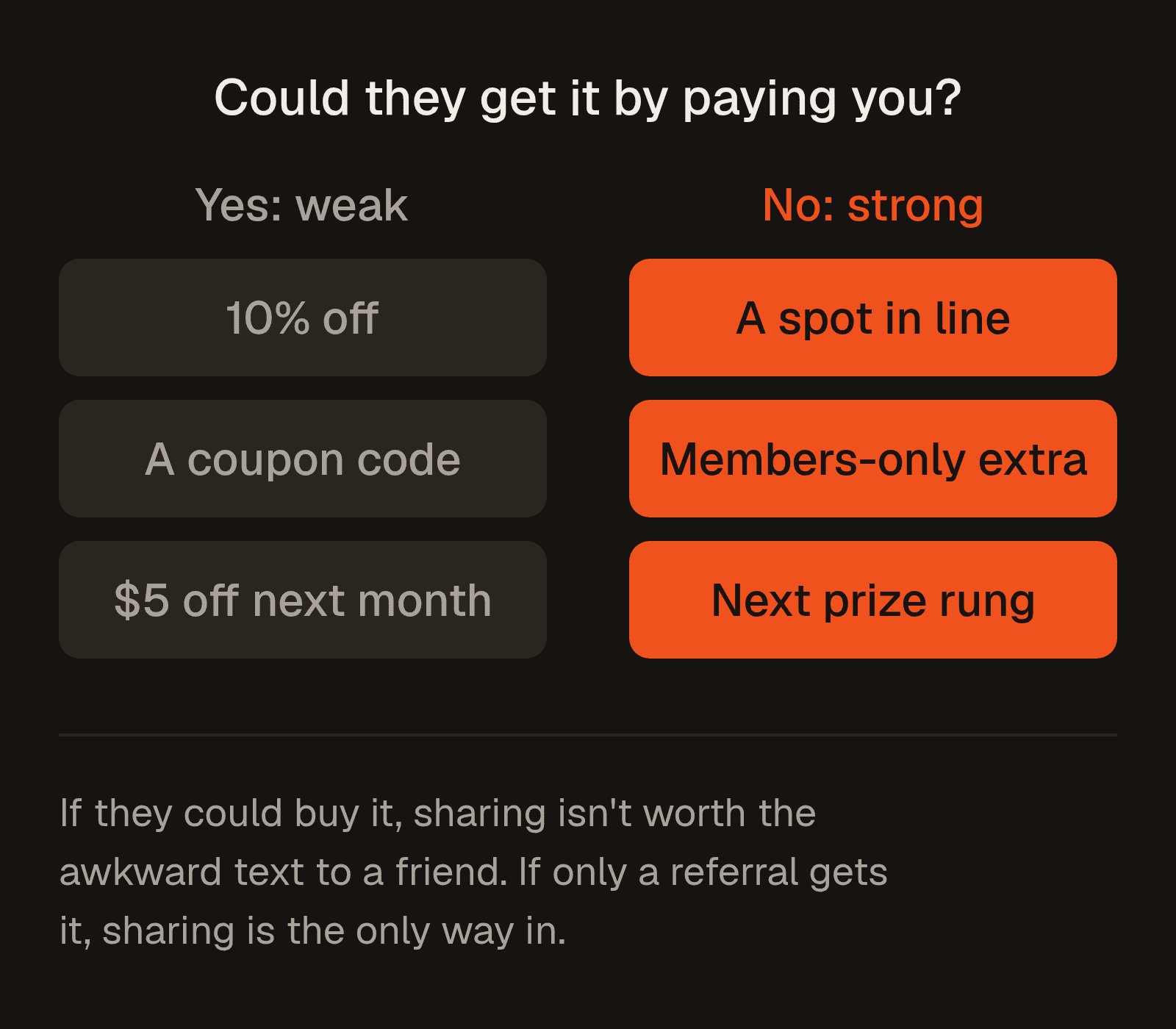
Why 10% off doesn't work
Sales happen. Codes leak. Anyone who waits long enough gets the same 10% for doing nothing. So asking someone to text three friends for it feels like a bad trade, even if they can't say why.
It also costs you twice. You pay for the discount, and you teach your users that your price is negotiable. That gets expensive later if you charge a subscription.
Three companies, three rewards you can't buy
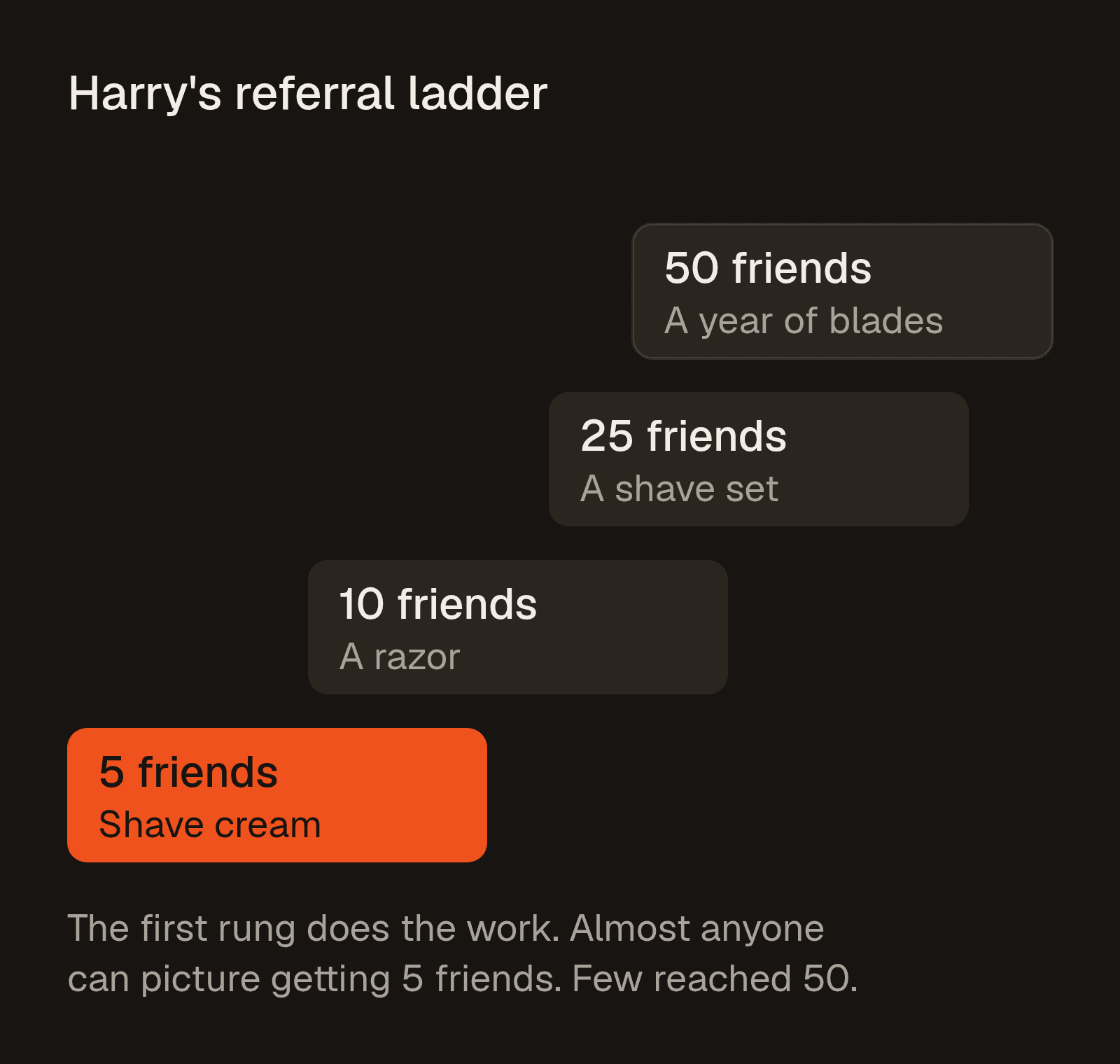
Harry's: a ladder of prizes. Harry's is a razor brand. Before it had razors to sell, it put up a sign-up page that showed what you'd get for sharing: 5 friends got you free shave cream, and the prizes climbed until 50 friends got you a year of free blades. About 100,000 emails came in the first week, and 77% of them came through referrals.
What people miss: the top prize wasn't the point. Only about 200 people ever reached 50. The bottom rung did the work: almost anyone could picture getting 5 friends to sign up, and once people cleared it, they kept climbing.
Morning Brew: something only insiders get. Morning Brew is a free daily business newsletter. Get 3 friends to subscribe and you unlock Light Roast, a Sunday edition other readers don't get. After that come stickers, a private community, then shirts and mugs. Over 75,000 readers have cleared 3, and referrals brought in more than 30% of its 1.5 million+ subscribers, at roughly 25 cents each.
What people miss: the mug isn't merch. A Morning Brew mug on someone's desk tells the room what they read. This only works if your users already see themselves as a certain kind of person because of your app.
Robinhood: a better spot in line. Before launch, Robinhood, the stock trading app, was one sign-up page with a number on it: your place in line. Every friend who joined through your link moved you up. A million people were waiting by launch day.
What people miss: the reward cost Robinhood nothing. But it has an expiry date. It stops working the moment anyone can just sign up.
Which one fits your app
Answer these in order and stop at the first yes.
| Question | If yes, use | What it looks like |
|---|---|---|
| 1. Haven't launched yet? | A spot in line | A waitlist that shows your real position and moves you up when a friend joins |
| 2. Do your users call themselves something because of your app? | Insider rewards | A private tier, a hidden feature, first look at what's next, something to wear or post |
| 3. Neither? | A ladder | Prizes that grow with each referral, made from your own product: premium time, credits, unlocks |
A few notes:
- Only use a waitlist if the limit is real. Fake scarcity gets found out in one screenshot.
- Insider rewards fit fitness, finance, learning and community apps. For a plain utility, they usually end up as 400 stickers in a drawer.
- A ladder made of your own product is the cheapest reward there is. A month of premium costs you almost nothing and is worth your full price to them. If your app is free, use limits you already have. Don't add a new limit just to hand it back as a reward. Users notice when a wall goes up the same week the referral screen does.
Other rewards that can work
| Reward | Example | Fits when |
|---|---|---|
| Both people get more of the app | Dropbox: extra storage for you and your friend | Your app has something metered: storage, credits, seats |
| Your friend gets a gift | Uber and Airbnb: credit toward your friend's first ride or stay | The first purchase is what stops new users |
| The invite is the app | Venmo, shared albums, shared docs | Your app is worse alone. This beats every other option if you have it |
| A random prize | Robinhood after launch: a free stock, usually about $5, sometimes $200 | You can afford it at 1,000 referrals. Check your local rules on prize draws |
| A cut of the money | Affiliate and ambassador programs | Your app is pricey enough for a commission to matter. Not for a $3 app |
Whatever you pick, check two things: the referrer couldn't just buy the reward from you, and you could afford it at 1,000 referrals, not just 10.
What makes any of them work
- Make the first rung easy. 3 to 5 friends. Harry's started at 5 and Morning Brew at 3. Start at 10 and nobody steps on, and you'll decide referrals don't work when you really tested one bad number.
- Show the count. Robinhood showed your place in line. Morning Brew shows a progress bar. If people can't see their count, it isn't a game, it's paperwork.
- Ask right after the aha moment, not at install. Nobody recommends an app they've had open for eleven seconds. Ask right after your app does the thing it exists to do.
- Decide on purpose whether the new person gets something too. Giving them something turns "do me a favor" into "here, have this". Skip it when the reward is status.
The catch on mobile
The App Store doesn't tell you who referred whom. Someone taps a friend's link, lands on the store page, installs, and the app has no idea where they came from.
The simple fix is a referral code. The referrer gets a short code, the new user types it in during sign-up, and you match them in your own database. Paid deep-link tools do the same thing more smoothly, but a code works on both stores and can ship this week.
Three things most guides leave out
1. A referral program speeds up word of mouth. It can't create it. Before you build one, message ten people who really use your app. Ask if they've told anyone about it, and what they said. If most say no, or can't describe your app in a sentence, fix that first.
2. Some apps shouldn't have one. A one-time purchase with nothing to give away and no reason for users to want each other there may not have a referral program worth building. That's a real answer, and better to reach it in an afternoon than a month.
3. The best share message is already written. Find the users who already recommend you and ask what they say. Use their words, not yours or an AI's.
The prompt
Paste this into ChatGPT, Claude or Gemini in a normal chat. It doesn't need web search, it needs to know your app. Swap the [BRACKETS] for your details first.
It does four things in order:
- Tells you whether to build a referral program at all, and stops if the answer is no.
- Picks one reward and explains why the closest alternatives are wrong for your app.
- Designs the tiers, prices them at 100 and 1,000 referrers, and writes the copy.
- Sets the number that tells you whether it worked, before you have numbers to get attached to.
Design a referral program for my app, and pick the ONE reward type that actually fits it.

My app: [WHAT IT DOES, in plain mechanics]
Who uses it: [WHO IT'S FOR]
Stage: [NOT LAUNCHED / LAUNCHED]
What one extra user costs me to serve: [e.g. near zero, or 40c of API calls, or a physical product]
What I charge: [FREE / $X once / $X per month]

Optional, paste at the bottom if you have them: my App Store or Play reviews, support emails, the exact words people use when they recommend my app.

Work in four parts and print all four.

=== PART 1: SHOULD I BUILD ONE AT ALL? ===

A referral program accelerates word of mouth. It cannot create it. Before designing anything, tell me straight whether I have something to accelerate.

Judge it on one thing: is there a moment where my user gets a result worth telling another person about, and could they say what my app did for them in one sentence?

If no, say so plainly, tell me what to fix first, and STOP. Do not design a program anyway to be helpful. A referral program on an app nobody mentions is a settings screen nobody opens.

If yes, name the exact moment. That is where the ask goes in part 3.

=== PART 2: PICK EXACTLY ONE REWARD ===

These three have the strongest evidence behind them, so start here:

PROGRESS: a ladder of rewards that gets more valuable as the referral count climbs. Fits when I can give something real away at every rung, and is cheapest when the rungs are made of my own product.
IDENTITY: something only referrers get, that marks them as an insider or that other people can see. Fits when my users already think of themselves as a type of person because of my app.
ACCESS: earlier entry. A visible position in a queue that moves when someone joins through them. Fits before launch, or before a genuinely capacity-limited release.

Those three are a starting point, not the whole space. Any of these is equally available to you:

MUTUAL: both sides get more of the product, out of something metered like storage, credits, seats or exports.
GIFT: the referrer hands the new person something, and their own reward is having been the one who gave it.
NETWORK: no reward at all, because the app is worse alone and the invite is a feature rather than a favor.
DRAW: each referral is an entry or a variable payoff rather than a guaranteed prize.
REVENUE SHARE: a genuine commission, for higher-priced products and people with their own reach.
CAUSE: the referral funds something outside the product that my users already care about.
COMPETITION: a public ranking of referrers, for users who already compete with each other in my app.

You may also propose something that is on neither list. If you do, name it in one line and say what makes it different from the closest thing above.

Rules:
- Pick ONE and commit to it. Do not hedge, do not blend two, and do not hand me a phased roadmap that quietly contains four.
- Say in one line each why the three closest alternatives are wrong for MY app specifically. If you can't argue against them, name the fact about my app you're missing instead of guessing.
- BANNED as the reward for the REFERRER: a discount on my own price, a percentage off, or credit against what they already pay me. Those buy a transaction instead of an advocate and they teach my users that my price is soft. Giving credit or money to the NEW person is a different thing and is allowed, because that is acquisition cost, but if you pick that, say explicitly that the referrer's reward is social rather than financial.
- Default to a referrer reward they could not simply buy from me at any price. If the design you pick makes it buyable, a draw or a commission for instance, say plainly why that's right for my app rather than arriving there because it was easy.

=== PART 3: DESIGN IT ===

Build the actual program for the type you picked.

- THE TIERS. Exact referral counts and exact rewards. The first tier must be clearable by someone with an ordinary number of friends: 3 to 5, never 10. Estimate what fraction of referrers reach each tier.
- If my app is free and has no paid tier, build the rungs out of limits that already exist in it, or out of access and status. Do NOT propose that I add a new restriction so I have something to give back as a reward. If you cannot find enough to give away without doing that, say so and send me back to part 2 with the reward you would pick instead.
- WHAT IT COSTS ME. Real numbers, using the per-user cost I gave you. Show the total at 100 referrers and at 1,000. If a tier is unaffordable at 1,000, redesign it now instead of warning me about it later.
- THE MOMENT OF THE ASK. The specific screen or event in my app, taken from part 1. Not "in settings", not "after onboarding".
- WHAT THE REFERRER SEES. Their count, their progress to the next tier, and how they get their link or code. Describe the screen.
- ONE-SIDED OR TWO-SIDED. Whether the new person gets anything, and why that's right here.
- THE EXACT WORDS. Write the message my user sends, the screen copy at the ask, and the notification when they clear a tier. Use my users' vocabulary, not marketing language. No exclamation marks and no "Refer a friend!". If I pasted reviews above, take the phrasing from those.
- FRAUD. Name the two most likely ways people will game THIS specific design, and the cheapest check that stops each.

=== PART 4: HOW I'LL KNOW IT WORKED ===

- The one number that tells me, defined precisely: what is counted, over what window.
- Three concrete figures for that number: dead, working, exceptional. Figures, not adjectives.
- How long to run it before judging.
- What to change first if it underperforms, and what not to touch.

Finish with one line: the single most likely reason this program fails, and what would have to be true for you to be wrong about it.
How to use it
- Fill in the brackets. Describe what your app does in plain words, no marketing. The line about what one extra user costs you matters most: it stops the AI from designing rewards you can't afford.
- Paste your reviews at the bottom if you have any. The words people already use to recommend you belong in your share message.
- Read part 1 first. If it says not to build one, that answer is worth more than the design would have been.
- Ship one rung. One reward, one ask, one code. Add more when people start clearing the first one.
Get better at growing apps.
New case studies and guides on how apps grow. Free, straight to your inbox.
Written by Matt Neves
I study how apps grow and break down the case studies for 20,000+ app builders as @agenticmatt. I test what I learn on my own apps.
More about meKeep reading
Acquisition · 5 min read
How to grow your app with no budget
Ads rent people's attention. Dropbox, Gymshark and Tinder borrowed it for free. The three places to borrow attention for your app, and how to start this week.
Acquisition · 2 min read
Find your first users with AI
Your first users are already posting about the problem your app solves. An AI research prompt that finds those threads and groups, and how to show up without spamming.
Growth loops · 5 min read
Growth is not marketing
More marketing into an app that loses people is a leaky bucket. How to find the hole where your users give up, and why patching it beats pouring in more.